Hej
Swedish Elias came to Thailand for a holiday. Today he plays for the national football team
March 8, 2026 - by
Helene Sadjadi-Munk
A visit to family in southern Thailand changed the course of Swedish-born defender Elias Dolah’s life. Eleven years later he plays for the Thai national team and has built a life far from the small village outside Lund where he grew up.
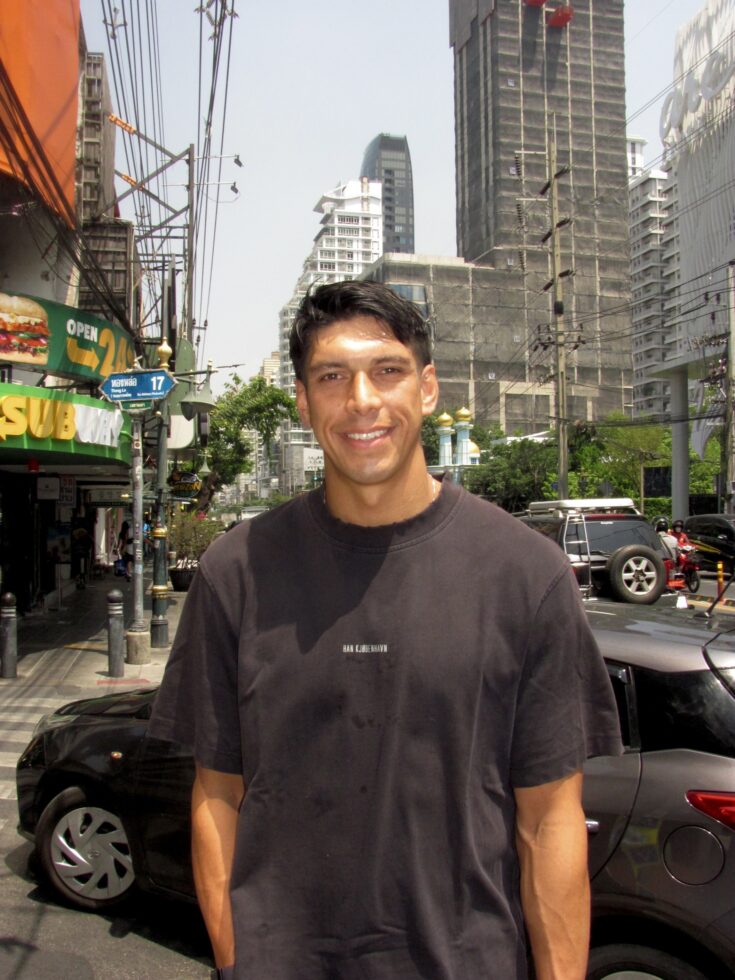
Elias Dolah grew up in a small village outside Lund in southern Sweden before football eventually took him to Thailand. Photo: Helene Sadjadi-Munk
Bangkok moves fast.
Motorbikes squeeze between cars. Taxis honk. People rush past cafés and food stalls.
In the middle of it all is Elias Dolah. Calm. Almost unmoved by the pace around him.
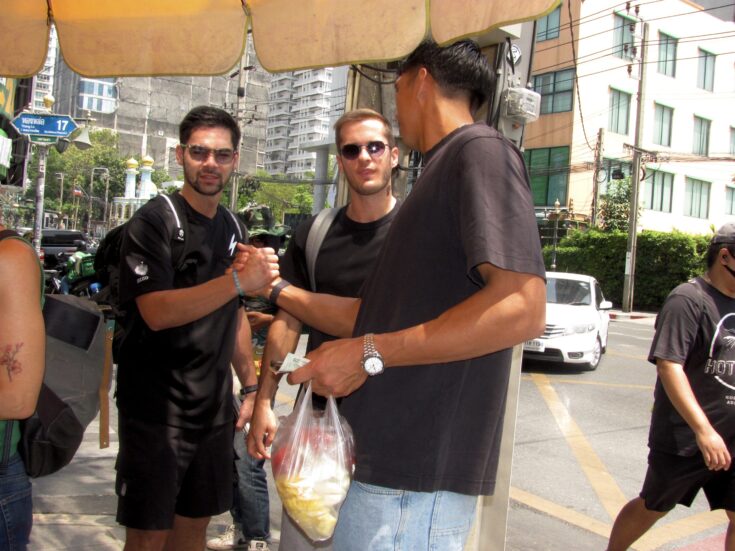
People recognise him. Several stop to say hello as they pass. A quick greeting here. A short conversation there. Colleagues from football. Someone who knows his fiancée. And his fiancée herself. Familiar faces appearing in the middle of the Bangkok rush.
It says something about him.
Yusef Elias Dolah, who just goes by Elias, is not loud or attention-seeking. But people seem to gravitate towards him. He greets everyone with the same easy smile before continuing on his way.
“I actually feel like Bangkok goes a bit too fast for me,” he says quietly.
“My fiancée, Dorothy, grew up in Phuket, and I can definitely see myself living there one day.”
The two met in Bangkok about six years ago at a birthday party through mutual friends.
“We clicked immediately,” Dolah says.
She even gave him a nickname that some fans now use when they recognise him.
“She calls me ‘P Jak’ which means big giant,” he says with a smile.
For now, however, the 32-year-old defender is firmly rooted in Thai football. Nearly two metres tall, he has become a recognisable figure on the national team and in the Thai League. He currently plays on loan at BG Pathum United from Buriram United.
But the road here began far away from Thailand.
Growing up Swedish
Elias Dolah was born near Lund in southern Sweden.
His father is Thai, originally from the three southern provinces where many people identify as Malay Muslims. His name Yusef Elias itself comes from the Quran.
Yet Elias’ childhood felt unmistakably Swedish.
“I grew up in a small village outside Lund. All my friends were Swedish. That shapes you.”
More than a decade after arriving in Thailand as a young player, the country has gradually become home. Photo: Helene Sadjadi-Munk
He grew up with an older brother and an older sister in a household where family routines mattered and where time together was important.
In modern life, he says, it is easy to lose those small traditions that keep a family close. In his home, his father made sure that did not happen.
“My dad always said dinner together was important. You could not miss dinner.”
In that way, his father also carried parts of his own background into the household. Not through strict rules, but through small things – traditions, culture and the values he had brought with him from southern Thailand.
“He never enforced religion on us. But he brought culture with him.”
And growing up between cultures sometimes left questions.
“My siblings and I would sometimes wonder a bit who we were,” Dolah says.
“It can be difficult to find your identity when you grow up between places.”
Sport eventually became the space where identity felt simple.
“I played everything when I was young. Football, floorball, badminton, table tennis. Even hockey in the winter, when the local lake froze.”
Music also filled his teenage years.
“I played bass in a band from when I was about 15 until I moved to Thailand at 20. My brother played saxophone. The band was with friends I had known since childhood.”
But football slowly began to take centre stage.
After finishing school he joined Lund’s team in Sweden’s third division. The level was semi-professional, which meant football alone could not pay the bills.
“So I worked as a substitute teacher at the high school I had gone to,” he says.
“And I also worked in the village grocery store.”
At the same time he was applying for university. One programme in particular caught his attention.
Nearly two metres tall, Elias Dolah has become a commanding presence in defence for both club and country. Photo: Supakit Wisetanuphong
“I applied to become a fire engineer.”
He pauses for a moment when he says it.
“And I’m so happy I didn’t get accepted.”
He ended up number ten on the waiting list. Looking back, he believes that rejection changed everything.
The decisive envelope
While still under contract with Lund, Dolah travelled to Thailand with his father to visit family.
At the time he still had a year left on his contract in Sweden and had no plan to leave Europe for good. The trip was simply meant as a visit.
During the stay his father suggested that he try training with a local club in southern Thailand.
After a few days, the club owner came to meet him.
“He said he really liked me and wanted me to come back and play for him.”
Then came the moment Dolah still remembers clearly.
“He gave me an envelope with 50,000 baht in cash.”
For a young player who had been juggling football with substitute teaching and supermarket shifts in Sweden, the offer felt surreal.
“I was still on holiday but I thought: okay, let’s go.”
He returned to Sweden to finish his contract with Lund. But the idea had already taken hold.
The following year, at just 20 years old, he moved to Thailand.
Injuries, loss and resilience
The move to Thailand did not lead to instant success.
In his first season he played only seven matches before suffering a serious knee injury.
“I slid into the goal post and had multiple injuries in my knee.”
The injury kept him out for more than a year. And injuries have continued to test him throughout his career.
Most recently he spent months recovering from a torn Achilles tendon. For a footballer, that kind of waiting can be mentally exhausting.
“It was kind of depressing. You see your teammates play, and you just want to play yourself – but something is stopping you.”
Determined to recover, he searched for help wherever he could find it. At one point, that search even took him to Lebanon to work with a specialist.
“I flew to Beirut to see a guy who works with fascia in the muscles. We did very strange exercises, but it helped,” he says.
The trip became memorable for another reason as well.
As he moves through Bangkok, Elias Dolah is often stopped by familiar faces – friends, colleagues and people who recognise him from football. Photo: Helene Sadjadi-Munk
“While I was there, Israel bombed Beirut. I could hear drones flying overhead.”
But the hardest moment of his career had nothing to do with football.
Two years ago his mother passed away after battling cancer.
At the time Dolah was playing for Bali United and travelling with the team. He was in Hong Kong for a match when his sister called.
“She told me I had to come home immediately.”
He flew from Hong Kong to Copenhagen and then took a taxi across the Øresund Bridge to Sweden, telling the taxi driver to go as fast as possible.
He arrived during the day. Later that night his mother passed away.
“It almost felt like she was waiting for me to come home.”
During this period, football became one of the few places where his mind could briefly rest.
“When you’re playing football it’s a relief. You forget what you’re struggling with.”
Building something beyond football
More than a decade after arriving, Thailand has gradually become home.
When Elias Dolah first came to the country, the goal was clear.
“My dream was always to play for the national team.”
In the early days he stayed in a hotel that overlooked the stadium. From his room he could see the pitch.
“I remember thinking: one day I want to play there.”
Today he has represented Thailand internationally for several years. Looking back, he still finds it difficult to fully grasp how far the journey has taken him.
“Thailand has given me so much – things I couldn’t even imagine ten years ago. I’m super grateful for my journey.”
Much of that journey has been tied to Buriram United, one of Thailand’s most successful football clubs. The team has won the Thai League multiple times and regularly competes in the AFC Champions League.
The club is led by a former national politician who is widely respected in Buriram for helping develop the city.
Inside the club, the relationship with the leadership feels almost familial.
“We actually call him ‘dad’ at the club,” Dolah says with a smile.
While Dolah’s playing career continues, he has also begun to think about what comes after football. A few years ago he helped start a football academy in Bangkok together with two partners.
“I co-founded a football academy three years ago. We have about 150 kids now.”
Off the pitch, Elias Dolah is now helping young players through a football academy he co-founded in Bangkok. Photo: Helene Sadjadi-Munk
The project grew out of a realisation that Dolah could not change everything happening in the world – but he could try to make a difference in his own surroundings.
“When I was younger I followed the news a lot. But I realised it didn’t give me anything. The world is so weird,” he says.
“I try to protect my peace. What I can’t control, I won’t bother too much about. I try to do what I can around me.”
One way of doing that is the academy.
“Some pay and some are on scholarships because many kids here need opportunities.”
For Dolah, the contrast with Scandinavia is noticable. Growing up in Sweden, organised sport was everywhere supported by schools, clubs and public funding.
“Here it’s different. Kids need opportunities.”
At the same time he is preparing for new national team matches and working on launching a gym project in Bangkok.
Yet when he thinks about the future, the picture is relatively simple:
Football for as long as the body allows.
Family.
And perhaps one day a quieter life closer to the sea. Maybe in Phuket, where Dorothy grew up.
A visit to family in southern Thailand changed the course of Swedish-born defender Elias Dolah’s life. Eleven years later he plays for the Thai national team and has built a …

scandasia.com
Mvh isan lover


 www.aftonbladet.se


 men alla är vi olika.