Hej
Policy vs reality: The true cost of Thailand’s ‘free’ education
16 May 2026 by Thai PBS World
Flaws in Thailand’s “free education” policy are back under the spotlight as schools reopen for the new term. Hidden fees remain a problem for low-income families already struggling with rising living costs, placing millions of children at risk of dropping out.
For many parents, the promise of “15 years of free education” is merely a slogan, not a reality.
“I have already spent more than 6,000 baht on my son’s schooling this term,” said one mother, a construction worker. The school had presented her with a bill of 5,050 baht for an “academic foundation adjustment” course. She also had to pay for books and uniforms.
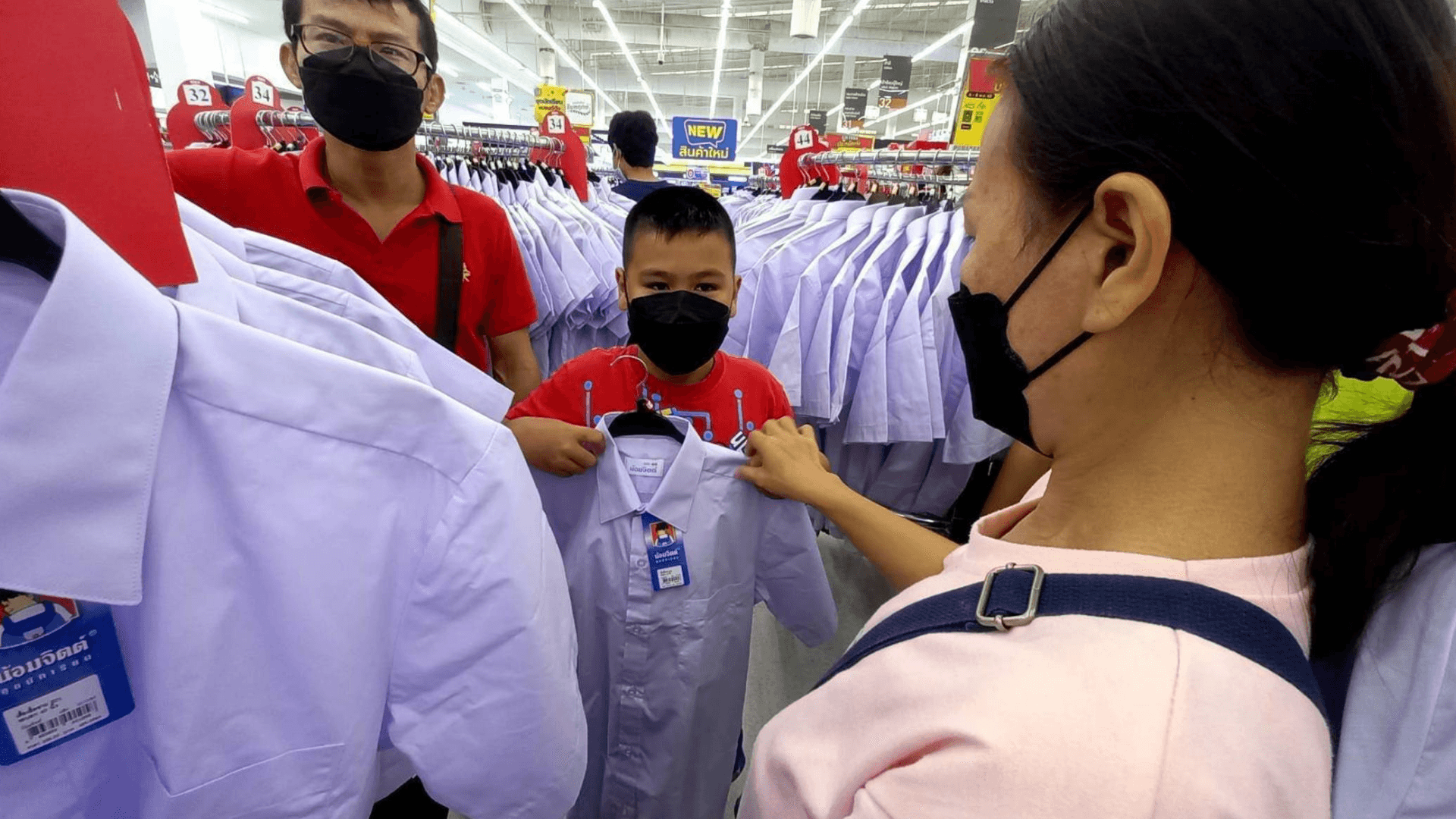
Just days before the semester began, the young mother took her son to a donation stall to pick up second-hand uniforms. Set up by the Mirror Foundation in a fresh market in Nonthaburi, the stall aims to help parents cope with rising education burdens.
The construction worker said she faced a daily struggle to make ends meet on her minimum daily wage of barely 300 baht.
“My budget is stretched to the limit. I toil under the scorching sun all day, so skipping meals is not an option,” she said.
The rising cost of learning
According to a recent survey by the University of Thai Chamber of Commerce (UTCC), back-to-school spending rose 6% this year to an estimated 66.37 billion baht – a record high.
The average family sets aside nearly 30,000 baht to cover expenses during the school-opening period, the survey of 1,250 households found.
Parents of children in regular state education reported average added expenses of roughly 11,000 baht. However, costs for children in state-funded special schools were significantly higher.
Nearly half of the respondents cited higher transportation and school-supply costs as the main source of this year’s surge in expenses. Meanwhile, one in four parents (27%) said they were forced to turn to relatives, pawnshops or loan sharks for funds to keep their children in school.
Children at risk
Roughly 3 million children in Thailand live below the poverty line, according to data from the Equitable Education Fund (EEF).
For these families, the average cost of “free” schooling – covering uniforms, transport and meals – is roughly 9,420 baht per term. This amount is equivalent to around two months of earnings for the poorest 15% of households.
Pavarin Bhandtivej, head of data analysis and inequality monitoring at the EEF’s Equitable Education Research Institute, noted that the cost-of-living crisis has significantly increased the financial burden on poor families.
“Their expenses have risen by an average of more than 1,000 baht a month,” he said.
Pavarin expressed concern that financial constraints are taking a toll on children’s future prospects.
EEF data shows that only 12.5% of children from the poorest families go on to higher education – a rate far lower than the national average.
“Overall, our survey found that 22% of children could not afford to enter higher education,” he said.
However, the impacts of education inequality are most visible at school.
In 2024, Thailand recorded a staggering figure of over 1 million school dropouts. That number dropped but remained significant in 2025, with 603,065 children quitting education early.
“This inequality can only be effectively tackled with concrete policies or measures,” Pavarin said. Failure to bridge this education gap will jeopardise not only children’s futures but also Thailand’s long-term economic health, he added.
The ‘hidden fee’ loophole
Thailand has mandated 15 years of free education since 2009, covering the time from kindergarten through Grade 12 (Mathayom 6). To protect this policy, the Education Ministry has banned 22 specific charges – including fees for tuition, libraries or internet use. However, parents frequently complain of “hidden fees” for everything from air-conditioning and native-speaking foreign-language teachers to “mandatory” extra classes.
Asst Prof Athapol Anunthavorasakul, who teaches at Chulalongkorn University and also chairs a Thailand Consumer Council subcommittee, attributes these extra costs to lax law enforcement and legal loopholes.
“Even though the government claims it covers all 22 basic education expenses, many parents are still paying hefty sums,” he said.
In one example, the current uniform subsidy is roughly 400 baht per primary school student, but the actual cost to kit out students is much higher. Meanwhile, the government’s annual subsidy for learning equipment is just 440 baht per head, meaning schools often call on parents to cover the shortfall. For learning activities, the government just pays 547 baht per students, leaving parents to cover costs for activities like school trips.
Emergency measures for 2026
To ease the pressure on parents, the Office of the Basic Education Commission (OBEC) has introduced seven measures for the 2026 academic year. These include cutting school maintenance fees, relaxing uniform requirements, removing unnecessary learning materials and limiting expensive extracurricular activities.
“There’s no need to buy full scout uniforms; students can wear just the scarf and hat,” Education Minister Prasert Jantararuangtong said.
Schools have also been instructed to relax rules on shoe and bag brands for students.
Critics say these steps are merely superficial, arguing that structural reform is required to solve the problem.
Former MP Surawat Thongbu urged the government to redirect the massive budget of 29 billion baht for student tablets and laptops towards essential learning materials and books.
“Such a shift would boost the overall quality of schooling,” he said.
Policy vs practice
Asst Prof Athapol called on the Education Ministry to provide more support to cash-strapped schools and identify students who are at risk of dropping out. These steps should be taken at the start of every academic year, he said.
“Every child should be allowed to complete their education without discrimination. Schools should also be barred from withholding transcripts and certificates just because the parents can’t settle bills,” he said, adding that this practice blocks students from furthering their studies or applying for jobs.
Flaws in Thailand’s “free education” policy are back under the spotlight as schools reopen for the new term. Hidden fees remain a problem for low-income families already struggling with rising living costs, placing millions of children at risk of dropping out.
world.thaipbs.or.th
Mvh isan lover