

Isan Lover
Forumveteran
Hej
Phuket draws around 13 million visitors a year to an island whose roads, pipes, and waste systems were built for far fewer people. For many Thai residents, the visible fights on Bangla Road are only the loudest sign of a much larger problem.
Water shortages, mountains of waste, rising housing costs, and tourism spending that bypasses Thai-owned businesses have pushed local frustration into public view. The pressure starts with who comes to Phuket, how they spend, and how long they stay.
Bangla Road in Patong has become the symbol of that anger. Drunk tourists reportedly fight there so often that Thai people have begun calling it “Bangla Stadium.” Clips of these confrontations spread quickly, along with calls to blacklist or remove problem visitors.
Communities clustering together is normal. London has Chinatown, and major cities have Little India neighborhoods. Phuket’s tension comes from the scale of the arrivals, the pressure on limited space and services, and the way some tourism networks operate almost entirely outside the local economy.
A family can reportedly live in that part of Phuket for years without needing Thai or English. The issue is not the presence of a Russian community. It is that spending can remain inside a self-contained network while the island still carries the cost of additional residents.
The area is also known locally for nighttime scooter rodeos, revving engines under apartment buildings, and further incidents. The point is not that every person in a community causes trouble. The island’s density and social separation can make conflicts spread quickly.
The group may spend six days on a Thai island and leave without much of its money reaching Thai-owned businesses. More arrivals do not always mean more income for local businesses.
For a shopkeeper in Chalong, Phuket’s visitor total can grow sharply without producing another baht in revenue. Meanwhile, tourists outside these networks may feel overcharged because some businesses see them as one-time customers rather than people who will return.
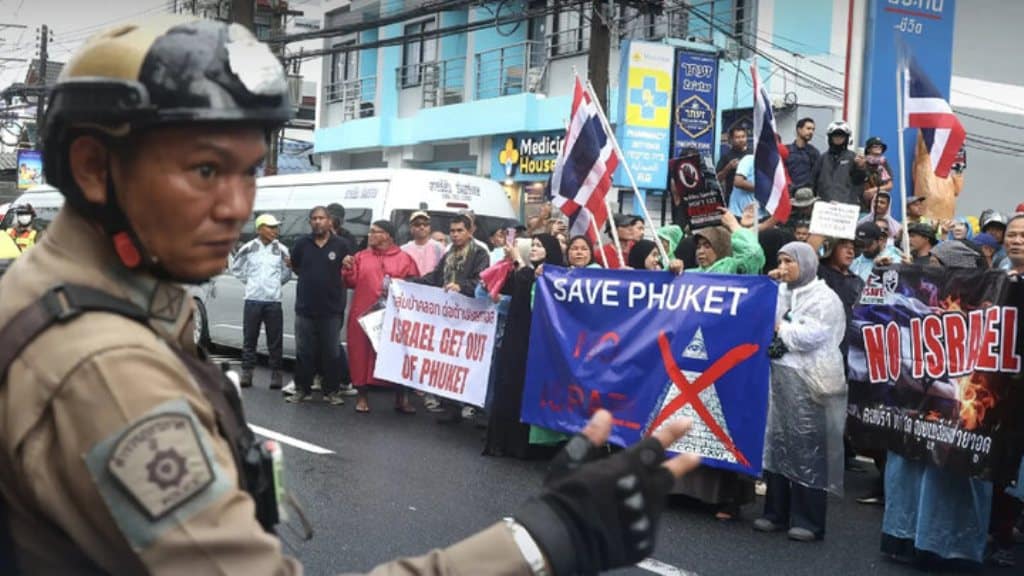
In Patong, a tour worker reportedly lost control during an argument with an Israeli tourist and told him to leave. Later, a video of a foreign tourist accused of defecating on a food stall in Bangkok circulated across Thailand within hours.
These incidents are not proof that foreign visitors as a whole behave badly. However, they have become shorthand for a frustration that has been building for years, especially in places where residents and visitors compete for the same streets, services, and housing.
Those figures do not include the millions of short-term visitors who arrive each year, or the long-stay foreign residents who remain on the island month after month.
The Phuket Tourist Association has raised the same concern for years: tourism expanded, but the systems that support daily life did not keep pace. Waste and water offer the clearest evidence.
The difference goes into the ground, and it has been accumulating for more than 20 years. The Pollution Control Department estimate cited in the video puts recycling at only 10% of the island’s waste.
Waste collected each day[/td][td]1,000 tonnes[/td]
IIncinerator capacity each day 700 tonnes
Waste recycled About 10%
Waste sitting on the surface About 1.3 million tonnes
Total when buried waste is included Up to 2 million tonnes
The provincial governor said the waste mountain could become a public park within two years. Yet the island continues to produce more waste each day than it can process.
Hotels deal with the shortage by purchasing water from private suppliers and absorbing the cost. A hotel cannot easily charge guests extra for a shower, a swimming pool, or an infinity pool.
Officials have discussed a $790 million pipeline from a mainland dam as a permanent answer. However, the irrigation office confirmed in March that major construction had not started and that large projects remained in study or feasibility stages.
Tourist behavior can create visible problems, but it does not explain a water and waste system that was never expanded fast enough.
The people exposed to that pressure include Thai families, taxi drivers, noodle sellers, small hotel owners, and migrant workers who moved to Phuket for jobs. Their livelihoods depend on tourism, but they also live with its rising cost.
Thailand’s economy shrank by 6.1% in 2020, its worst year in more than two decades. The tourism industry had stopped, and the country needed to know if international demand would return.
Phuket reopened before much of Thailand in July 2021. The plan was simple: visitors could land on the island, remain there, and show whether travelers still wanted to come back.
They did. By 2024, Thailand had reached 35.5 million visitors, close to its pre-pandemic record. Yet the return in arrivals did not produce the same return in tourism revenue.
That gap matters because prices across Thailand had risen over those six years. If comparable visitors were spending at the same level, each person should have left more money behind.
The argument is that Thailand recovered visitor volume while attracting more people who stayed longer and spent less. Phuket then absorbed the population pressure without receiving the economic benefit expected from the arrivals.
The remote-work visa ran for five years and allowed stays of up to 180 days per entry. Applicants could qualify by showing the equivalent of $15,000 in savings or by enrolling in a Muay Thai course. Around 35,000 people applied in the first 12 months.
The average visitor to Thailand stays about nine days. A family visiting Kata from Manchester for two weeks has little use for a 60-day visa. The longer stay is more useful to people who want to live in Phuket cheaply for extended periods.
Every two months, that person flies to Kuala Lumpur for a night and returns with a new stamp. He earns in euros while living on a Thai teacher’s budget, and each return through Phuket Airport adds another arrival to Thailand’s tourism count.
There is no personal attack in that description. The concern is cumulative. One person may have a small impact, but thousands of people living this way add to demand for housing, water, roads, and services throughout the year.
The same low-budget long-stay system has produced another problem: homeless foreign residents. A Bangkok charity reportedly picked up 45 foreigners over eight months who had entered on easy visa terms, run out of money, and had nowhere left to sleep.
That result helped push immigration authorities toward a tougher response.
The policy has been described as “No Entry, No Stay, No Escape.” Officers now ask for proof of onward travel and proof of funds, and they can reject people who have stacked too many back-to-back tourist visas.
Applicants must now apply in their country of citizenship or a country where they have legal residence. They also need a police clearance certificate.
After the Bangkok food-stall incident, Prime Minister Anutin ordered police to enforce public-order laws against tourists and told officers to stop allowing misconduct to slide. The Ministry of Tourism’s direction, as described in the video, is clear: favor quality tourism over quantity.
The taxi driver in Kathu, the woman running a noodle shop behind Karon, the owner of a 14-room hotel, and the migrant worker who came to Phuket for employment all depend on a busy tourism economy.
It was Thailand’s first annual fall outside the pandemic in about a decade. Meanwhile, Vietnam was up 13.8%, and Hanoi was aiming for 25 million visitors by December.
The reasons given are direct. Flights and hotels in Thailand cost more than they did three years earlier. Vietnam simplified its visa rules and remained cheaper, so a week in Da Nang can cost less than a week in Phuket.
Thailand had hoped to attract 40 million visitors in 2025, according to reporting on the country’s tourism target. Instead, the country faced falling arrivals while nearby destinations made entry easier and kept costs lower.
That leaves Thailand with a difficult position. Budget travelers may go elsewhere after tighter visa checks, but wealthier travelers have no reason to stay loyal if they can find cheaper beaches, easier entry, and a better experience in another country.
Phuket survived the 2004 tsunami. It also survived two years with an almost empty airport during COVID. The island has never lacked demand.
Phuket’s threat is that 13 million people want the same three beaches while the systems behind those beaches cannot keep up.
Thailand is trying to reduce the pressure by tightening the border and seeking higher-spending visitors. Yet waste, water, roads, housing, and the livelihoods tied to visitor volume still need an answer.
 www.chiangraitimes.com
Mvh isan lover
Phuket’s Overtourism Crisis: Waste, Water, and Visa Crackdown
September 16, 2026 12:38 pmPhuket draws around 13 million visitors a year to an island whose roads, pipes, and waste systems were built for far fewer people. For many Thai residents, the visible fights on Bangla Road are only the loudest sign of a much larger problem.
Water shortages, mountains of waste, rising housing costs, and tourism spending that bypasses Thai-owned businesses have pushed local frustration into public view. The pressure starts with who comes to Phuket, how they spend, and how long they stay.
The Phuket Visitors Don’t See
Travel brochures show beaches, hotels, and nightlife. Yet Thai social media is full of anger about Phuket’s crowding, public disorder, and the cost of living on an island where local families once farmed.Bangla Road in Patong has become the symbol of that anger. Drunk tourists reportedly fight there so often that Thai people have begun calling it “Bangla Stadium.” Clips of these confrontations spread quickly, along with calls to blacklist or remove problem visitors.
Removing disruptive tourists would not remove the rubbish at Saphan Hin, restore water pressure in Patong, or make housing affordable for local families. Those problems come from years of growth without matching investment in infrastructure.The problem is not only bad behavior. It is the sheer number of people on an island that was never built to carry them.
Visitor Communities Can Become Closed Loops
Phuket Airport’s largest visitor groups include Russians, Chinese, Indians, South Koreans, British travelers, Israelis, and Saudis. Russians and Chinese alone account for an estimated 10,000 to 12,000 passengers a day through the airport.Communities clustering together is normal. London has Chinatown, and major cities have Little India neighborhoods. Phuket’s tension comes from the scale of the arrivals, the pressure on limited space and services, and the way some tourism networks operate almost entirely outside the local economy.
Russian-speaking Bang Tao
In Bang Tao, Cyrillic signs are common. A Russian visitor can find a Russian real estate agent, gym, school following a Russian curriculum, and airport transfer arranged through a Russian intermediary who works with local drivers.A family can reportedly live in that part of Phuket for years without needing Thai or English. The issue is not the presence of a Russian community. It is that spending can remain inside a self-contained network while the island still carries the cost of additional residents.
Patong’s French area, known as “Les 4000”
A stretch behind Patong Beach has informally been called “les 4000,” a reference to a Parisian housing estate. It is associated with cheap low-rise blocks, shisha bars, and a French-speaking presence.The area is also known locally for nighttime scooter rodeos, revving engines under apartment buildings, and further incidents. The point is not that every person in a community causes trouble. The island’s density and social separation can make conflicts spread quickly.
Chinese tours and spending that bypasses local shops
The video describes Chinese tour groups moving through a closed commercial chain. A Chinese agency arranges the trip, places visitors in a connected hotel, directs them to selected restaurants, and sends them to shops on the itinerary, including latex pillow stores.The group may spend six days on a Thai island and leave without much of its money reaching Thai-owned businesses. More arrivals do not always mean more income for local businesses.
For a shopkeeper in Chalong, Phuket’s visitor total can grow sharply without producing another baht in revenue. Meanwhile, tourists outside these networks may feel overcharged because some businesses see them as one-time customers rather than people who will return.
Conflict Has Added to Local Anger
Several incidents have fed the public anger around foreign visitors. In June, a foreign tourist reportedly attacked a Muay Thai instructor with a metal pipe, leaving the instructor with a fractured eye socket.In Patong, a tour worker reportedly lost control during an argument with an Israeli tourist and told him to leave. Later, a video of a foreign tourist accused of defecating on a food stall in Bangkok circulated across Thailand within hours.
These incidents are not proof that foreign visitors as a whole behave badly. However, they have become shorthand for a frustration that has been building for years, especially in places where residents and visitors compete for the same streets, services, and housing.
Phuket Is Carrying More People Than It Was Built For
Phuket’s pipes, roads, and dumps were designed for a population of roughly 400,000 people. The island has about 418,000 permanent residents, plus around 130,000 registered migrant workers and another 400,000 people who come to support the economy.Those figures do not include the millions of short-term visitors who arrive each year, or the long-stay foreign residents who remain on the island month after month.
The Phuket Tourist Association has raised the same concern for years: tourism expanded, but the systems that support daily life did not keep pace. Waste and water offer the clearest evidence.
The rubbish mountain at Saphan Hinä
At Saphan Hin on Phuket’s east coast, the smell of the waste site arrives before the site itself. Phuket collects about 1,000 tonnes of rubbish a day, while its incinerator can burn around 700 tonnes.The difference goes into the ground, and it has been accumulating for more than 20 years. The Pollution Control Department estimate cited in the video puts recycling at only 10% of the island’s waste.
Waste collected each day[/td][td]1,000 tonnes[/td]
IIncinerator capacity each day 700 tonnes
Waste recycled About 10%
Waste sitting on the surface About 1.3 million tonnes
Total when buried waste is included Up to 2 million tonnes
The provincial governor said the waste mountain could become a public park within two years. Yet the island continues to produce more waste each day than it can process.
Patong’s nightly water shutoffs
In May, Patong residents faced water shutoffs between 10 p.m. and 5 a.m. The water authority cut pressure across large parts of Phuket after the Bang Wad reservoir, which supplies the district, fell to 27% full.Hotels deal with the shortage by purchasing water from private suppliers and absorbing the cost. A hotel cannot easily charge guests extra for a shower, a swimming pool, or an infinity pool.
Officials have discussed a $790 million pipeline from a mainland dam as a permanent answer. However, the irrigation office confirmed in March that major construction had not started and that large projects remained in study or feasibility stages.
Tourist behavior can create visible problems, but it does not explain a water and waste system that was never expanded fast enough.
Rising housing costs squeeze local residents
Housing pressure sits alongside the water and rubbish problems. Local families can no longer afford to live decently in places where their grandparents farmed.The people exposed to that pressure include Thai families, taxi drivers, noodle sellers, small hotel owners, and migrant workers who moved to Phuket for jobs. Their livelihoods depend on tourism, but they also live with its rising cost.
COVID Turned Phuket Into Thailand’s Reopening Test
When COVID-19 shut Thailand’s borders, airports emptied and hotels closed entire floors. Workers left Phuket and returned to their villages. For months, the island’s beaches had little more than dogs on them.Thailand’s economy shrank by 6.1% in 2020, its worst year in more than two decades. The tourism industry had stopped, and the country needed to know if international demand would return.
Phuket reopened before much of Thailand in July 2021. The plan was simple: visitors could land on the island, remain there, and show whether travelers still wanted to come back.
They did. By 2024, Thailand had reached 35.5 million visitors, close to its pre-pandemic record. Yet the return in arrivals did not produce the same return in tourism revenue.
More people, less spending per person
The video puts tourism revenue in 2025 at $46 billion, lower than the year before. It also compares average spending per visitor at roughly $1,450 in 2019, only about $50 more than the 2025 figure.That gap matters because prices across Thailand had risen over those six years. If comparable visitors were spending at the same level, each person should have left more money behind.
The argument is that Thailand recovered visitor volume while attracting more people who stayed longer and spent less. Phuket then absorbed the population pressure without receiving the economic benefit expected from the arrivals.
Visa Changes Brought More Long-Stay Visitors
In July 2024, Thailand expanded visa-free entry from 57 countries to 93 and doubled the stay period to 60 days. In the same month, it introduced a visa for people working remotely from a laptop.The remote-work visa ran for five years and allowed stays of up to 180 days per entry. Applicants could qualify by showing the equivalent of $15,000 in savings or by enrolling in a Muay Thai course. Around 35,000 people applied in the first 12 months.
The average visitor to Thailand stays about nine days. A family visiting Kata from Manchester for two weeks has little use for a 60-day visa. The longer stay is more useful to people who want to live in Phuket cheaply for extended periods.
The lifestyle described in Rawai
The video describes a familiar profile in Rawai: someone renting a studio month to month, paying about $90 for a scooter, and working from a cafe while buying one iced coffee.Every two months, that person flies to Kuala Lumpur for a night and returns with a new stamp. He earns in euros while living on a Thai teacher’s budget, and each return through Phuket Airport adds another arrival to Thailand’s tourism count.
There is no personal attack in that description. The concern is cumulative. One person may have a small impact, but thousands of people living this way add to demand for housing, water, roads, and services throughout the year.
The same low-budget long-stay system has produced another problem: homeless foreign residents. A Bangkok charity reportedly picked up 45 foreigners over eight months who had entered on easy visa terms, run out of money, and had nowhere left to sleep.
That result helped push immigration authorities toward a tougher response.
Thailand’s Immigration Crackdown
Immigration officers reportedly turned away around 30,000 foreigners at the border in the first five months of 2026. Authorities also arrested more than 14,000 people for overstaying or working without permission, and placed over 169,000 names on a blacklist.The policy has been described as “No Entry, No Stay, No Escape.” Officers now ask for proof of onward travel and proof of funds, and they can reject people who have stacked too many back-to-back tourist visas.
The remote-work visa became harder to access
At the end of August, Thailand closed a route that allowed people to apply for the remote-work visa in Vientiane or Savannakhet simply because they were already there.Applicants must now apply in their country of citizenship or a country where they have legal residence. They also need a police clearance certificate.
After the Bangkok food-stall incident, Prime Minister Anutin ordered police to enforce public-order laws against tourists and told officers to stop allowing misconduct to slide. The Ministry of Tourism’s direction, as described in the video, is clear: favor quality tourism over quantity.
Fewer Visitors Could Hurt Phuket’s Workers
Tourism accounts for about 12% of Thailand’s economy, according to the video. That means a crackdown cannot remove lower-spending visitors without affecting people whose income depends on volume.The taxi driver in Kathu, the woman running a noodle shop behind Karon, the owner of a 14-room hotel, and the migrant worker who came to Phuket for employment all depend on a busy tourism economy.
Thailand’s approach assumes it can reduce long-stay, low-budget travelers while retaining wealthier visitors. The risk is that affluent travelers may also choose somewhere else if Phuket becomes more expensive without solving its water, waste, and overcrowding problems.Every person filtered out of the system can also mean less income for a local worker or small business.
Vietnam, Indonesia, and the Philippines Are Gaining Ground
Thailand welcomed 32.9 million foreign visitors in 2025, a 7.2% decline from the year before. Travel Weekly Asia’s report on Thailand’s 2025 arrivals also cites the Ministry of Tourism and Sports figure of 32.9 million visitors and a 7.23% annual decline.It was Thailand’s first annual fall outside the pandemic in about a decade. Meanwhile, Vietnam was up 13.8%, and Hanoi was aiming for 25 million visitors by December.
Vietnam has passed Thailand for Chinese travelers
Vietnam passed Thailand as the top destination for Chinese travelers, according to the video. The Philippines and Indonesia are also gaining visitors.The reasons given are direct. Flights and hotels in Thailand cost more than they did three years earlier. Vietnam simplified its visa rules and remained cheaper, so a week in Da Nang can cost less than a week in Phuket.
Thailand had hoped to attract 40 million visitors in 2025, according to reporting on the country’s tourism target. Instead, the country faced falling arrivals while nearby destinations made entry easier and kept costs lower.
Phuket’s Future Depends on More Than Visitor Numbers
Phuket’s rubbish remains on the hill. Water still runs low in the dry season. The island’s infrastructure still struggles under the weight of its population and visitor traffic.That leaves Thailand with a difficult position. Budget travelers may go elsewhere after tighter visa checks, but wealthier travelers have no reason to stay loyal if they can find cheaper beaches, easier entry, and a better experience in another country.
Phuket survived the 2004 tsunami. It also survived two years with an almost empty airport during COVID. The island has never lacked demand.
Phuket’s threat is that 13 million people want the same three beaches while the systems behind those beaches cannot keep up.
Thailand is trying to reduce the pressure by tightening the border and seeking higher-spending visitors. Yet waste, water, roads, housing, and the livelihoods tied to visitor volume still need an answer.
Phuket's Overtourism Crisis: Waste, Water, and Visa Crackdown
Phuket draws around 13 million visitors a year to an island whose roads, pipes, and waste systems were built for far fewer people. For many Thai residents,
www.chiangraitimes.com
Mvh isan lover


